This article explains how to use the Fleets sub-module to capture tread depth readings for multiple vehicles from a single dialogue.
Overview
From the Fleet tread details screen you can:
Record inner and outer tread depths for every tyre position
Add a job number and comments for each vehicle
Cycle through all vehicles in a fleet using one streamlined interface
1. Open the Fleet Tread Details Screen
From the main menu, select Fleets.
Locate the fleet you want to update (for example, Haul).
On the right side of the fleet row, click the Tread depth icon
(see Image 1 – Fleets list (tread depth icon)).
This opens the Fleet tread details dialogue for that fleet.
Image 1 – Fleets list (tread depth icon)

2. Set Job Date and Job Number (Optional)
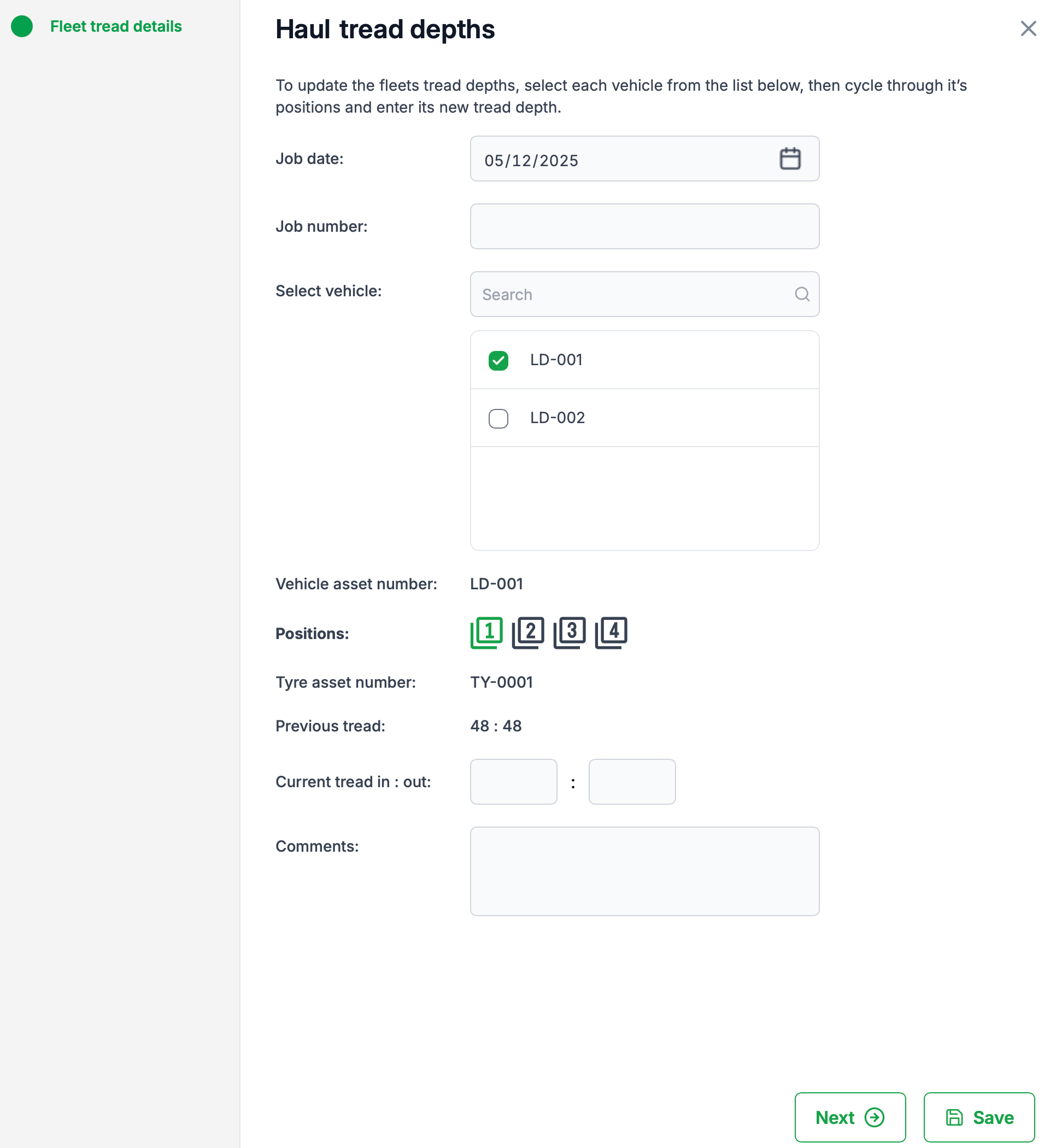
At the top of the Fleet tread details dialogue (see Image 2 – Fleet tread details):
Job date
Check the Job date field.
To change it, click the calendar icon and select the required date
(for example, to back-date a tread inspection).
Job number (optional)
Enter a Job number if you want to link these readings to a work order or maintenance job.
Image 2 – Fleet tread details
3. Select a Vehicle
In the Select vehicle panel, tick the checkbox for the vehicle you want to start with (e.g. LD-001).
Once selected, details for that vehicle are shown below:
Vehicle asset number
Positions (e.g. 1, 2, 3, 4)
Each position represents a tyre on that vehicle. Its asset number is also displayed.
4. Enter Inner & Outer Tread Depth Readings
For the selected vehicle:
Under Positions, click a position number icon (e.g. 1) to select the tyre you’re measuring.
The tread inputs for that position will be displayed:
Enter the Inner tread depth.
Enter the Outer tread depth.
(Optional) Add any notes in Comments (e.g. “Feathering on outer edge” or “Close to removal limit”).
Repeat steps 1–3 for each remaining position by clicking each position number icon in turn until all required positions on that vehicle are recorded.
5. Move to the Next Vehicle
When you have finished entering tread depths for the current vehicle, click Next (bottom-right of the dialogue).
The system will:
Store the tread data you’ve entered for the current vehicle within this session.
Move to the next vehicle in the Select vehicle list.
Repeat the same process (positions → inner/outer readings → comments) for each additional vehicle you want to update.
6. Save and Exit
When you’ve completed all required tread updates (for all vehicles or just some of them), click Save.
The system will:
Save all tread depth readings and comments entered during this session.
Close the Fleet tread details dialogue and return you to the Fleets list.
You do not need to complete every vehicle in the fleet in one go. Any data entered and then saved will be retained, even if some vehicles were not updated.
Tips
Use the Search box in Select vehicle to quickly find a specific vehicle in large fleets.
Ensure your Job date matches the actual inspection date for accurate history tracking.
Use Comments to flag tyres nearing removal, irregular wear or any issues needing follow-up.
By following these steps, you can efficiently capture accurate inner and outer tread depth readings for multiple vehicles from one central, easy-to-use dialogue.
Was this article helpful?
That’s Great!
Thank you for your feedback
Sorry! We couldn't be helpful
Thank you for your feedback
Feedback sent
We appreciate your effort and will try to fix the article